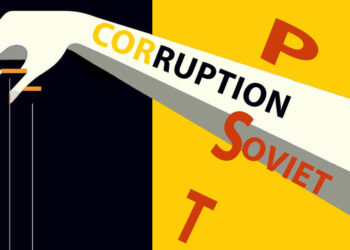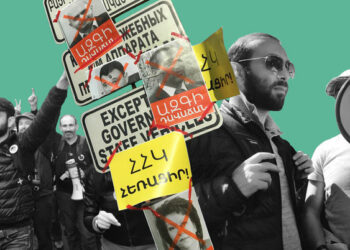

Professor Don Fuller examines how post-Soviet states have had difficulty in breaking normative behavior originating in Soviet times and how corruption is manifested in anti-democratic decision-making practices. He writes that Armenia’s new revolutionary government will be watched for evidence of competent innovation and justice.
First Deputy Prime Minister Ararat Mirzoyan sat down with EVN Report to talk about the challenges facing the new government as they prepare, among other things, to introduce reforms to the Electoral Code, make amendments to the Constitution to pave the way to snap elections and the potential introduction of transitional justice to deal with the sheer volume of corruption cases.
Is it possible to restore and rehabilitate Armenia’s judiciary? Vahe Grigoryan talks about the significance of a landmark judgment by the ECHR relating to the events of March 1, 2008 when security forces cracked down on peaceful protesters during post-election demonstrations leaving ten people dead.
Norik Gasparyan, a journalist from Tbilisi writes about the differences and similarities of two revolutions that took place 15 years apart in the South Caucasus: the Rose Revolution in Georgia and the Velvet Revolution in Armenia.
Formulating the compatibility of transitional justice with Armenia's laws and constitutional statutes shouldn't be problematic, writes Nerses Kopalyan. However, the Pashinyan government, must go out of its way to make certain that the formation of any element of the instruments of transitional justice are fundamentally impartial, profoundly non-politicized, and unequivocally objective.
Without social media and the press, the “Velvet Revolution” could have evolved completely differently. To some extent, what took place was in fact a media revolution. And now, post-revolution, we can register that the media landscape in Armenia is no longer what it was until April of this year. Samvel Martirosyan discusses some of the qualitative and quantitative changes in the Armenian media.
Armenia's post Velvet Revolution government came with the promise of snap elections, rooting out corruption and a new style of governance. A look at Prime Minister Nikol Pashinyan's and his government's first 100 days in office.
In this third part of our series on Electoral Code reforms in Armenia, Harout Manougian looks at the debate about quotas for women and ethnic minorities for the upcoming national elections.
Nerses Kopalyan examines and debunks the arguments that the arrest and detention of Armenia’s second President Robert Kocharyan is politically motivated and that the basis of the arrest lacks cogent and substantive legal foundations. Kocharyan has been charged with “overthrowing constitutional order” regarding the events of March 1, 2008 that left ten people dead.
EVN Report’s mission is to empower Armenia, inspire the diaspora and inform the world through sound, credible and fact-based reporting and commentary. Our goal is to increase public trust in the media. EVN Report is the media arm of EVN News Foundation registered in the Republic of Armenia in 2017.
SUPPORT INDEPENDANT JOURNALISM