

Visiting one post-Soviet state, you can then recognize it in all others – the similar patterns of urban planning and the identical buildings, structures, roads, pipes, wires, tiles, etc. However, an outsider delving inside under the extreme familiarity of the material environment finds an extreme “strangeness” of social interactions and practices. The “Outside In” series is about emplaced paradoxes and nuances. It spotlights the mundane in Armenia’s peripheral locations, where the seemingly unspectacular encounters with people and things allowing us to capture the unique features of the territory.
Listen to the article
O my Luve is like a red, red rose
That’s newly sprung in June…
(Robert Burns)
Outside In
Essay 11
It was the very beginning of June 2023, when I arrived in Goris to view an exhibition and spend several days with friends. On the first morning, I woke up at 5:30 a.m. to the sound of birds singing—nightingales, I believe, though maybe I just want them to be nightingales, as it is more poetic to think of them that way. I tried to fall asleep again, tossing and turning, trying to escape the dim morning light, but to no avail. My body was restless, craving movement, and the stress that had accumulated required an exodus. I got dressed and went outside into the cool loneliness of the early summer morning. The air was misty and wet with dew. Breathing deeply, I started to descend one of the narrow, empty streets, heading toward the exciting unknown that was awaiting me.
There are different practices people utilize to get acquainted with a place. Some read, some go on guided tours. I prefer urban drift [Fr: dérive]. Dérive involves wandering through spaces without a predetermined route or destination, allowing oneself to be guided by the contours, atmospheres, and ambiances of the environment. Letting thoughts run free and gut feelings guide my way, I learned Goris by taking baby steps that morning—by drifting in solitude. Without a map or a particular cause, I just moved, becoming lost and found in the dismembered hilly terrain of the city.
Memory is a fascinating yet deceptive mechanism through which we navigate space and time. When it comes to places, we recall them with a mix of sensory impressions, emotional undertones, fragments of past experiences, and aspirations about the future. Our brain often prioritizes the emotional significance of a place over its factual accuracy. Thus, memories are not infallible records of the past but are elusive and evolving stories, as much a reflection of places as of us. Details and shapes from places tied to happy memories may appear larger or more colorful in our recollections than they actually were, while those associated with less pleasant experiences may seem acyanotic, diminished, or vanish altogether.
My recollection of Goris that day is blurry, without a coherent story. It was too eraly, and my brain seemingly did not wake up to make a proper record. I will hardly recognize the paths I took or the landmarks I saw. Perhaps I imagined them, rather than encountered, distant outlines as if covered with water ripples. However, there are several details that stand out, bright flashes floating out of the fog of memory. They remain a stubborn constant that have ever since formed my subjective and over-romanticized image of the city. I have visited Goris several times since; yet it is that initial dérive that holds me hostage.
I remember walking past rows of tidy two-storey houses with carved wooden balconies and thick walls, all seemingly alike. Divergent from many other Armenian cities and towns, where shades of orange and pink tufa dominate, Goris is mostly constructed from gray stone arranged in a peculiar, elegant masonry. The dark gray natural stones appear to be embedded, as if sunken in the contrasting light gray concrete. Concrete envelops the sharp stones, giving them a smooth, rounded shape. The pattern reminded me of fish scales—those intricate and protective coverings that play a crucial role in the survival of fish. I am not sure if the masonry-like fish scales provided protection, but it certainly made the walls impressive and gave a unique aesthetic to Goris’ architecture.
Against the backdrop of gray, fish-scale-patterned walls, red and pink roses bloomed, creating a striking and romantic visual where nature blended seamlessly with manmade order. Untamed rosebushes climbed the walls, defying all odds and breathing life into the inanimate structures. They gently wrapped around the blue, red, or yellowish heavy arched doors, sprouting from the cracks in the masonry. In the soft milky light of early morning, dew-covered roses glistened, while by evening, they would take on the warm glow of the sunset, deepening into shades of burgundy and rich purple.
The distinct fragrance of the roses, carried by the breeze, added another layer of sensory pleasure to that morning. The way we perceive fragrances is largely individual; however, I will humbly attempt to provide a description. It was a mix of a sweet floral scent with a fresh, slightly citrusy note, overlayed by honey-like sweetness and a touch of musk. It made me lightheaded. A delightful state of being, like the invigoratingly fizzy first sip of sparkling wine for a Sunday breakfast. No rush, staying in the moment—breath in, breath out, observe.
As the city woke up, the fragrance of roses mingled with the scents of human activity—freshly baked bread and brewed coffee. At some point of my journey, I came across a small local bakery, which seemed to be among the first businesses to open its doors. The windows were slightly fogged from the oven’s warmth, but I could make out the silhouettes of several petite elderly women, preoccupied with work. As I stepped inside, the soft murmur of their conversation embraced me, creating a comforting, homelike background hum. The bakery is usually much more than just a place to buy bread and pastry, but a social heartbeat of the city, where people connect and catch up on the latest news and trade stories. I bid hello, bought a matnakash and sat on the curb opposite the bakery. The matnakash was still hot, burning my hands. Soon one of the women came outside and offered me coffee in a small, chipped cup with an engraved red rose. Tiny things of happiness—slowness, fresh coffee, hot bread, and red red roses.
A dog barked in the distance, a lawnmower hummed to life, and the occasional rumble of a car engine marked the start of the day as more people headed out for work or errands. Yet, despite the growing activity, the pace of the city remained unhurried. There was no rush; the day unfolded gently, with time enough for everything.
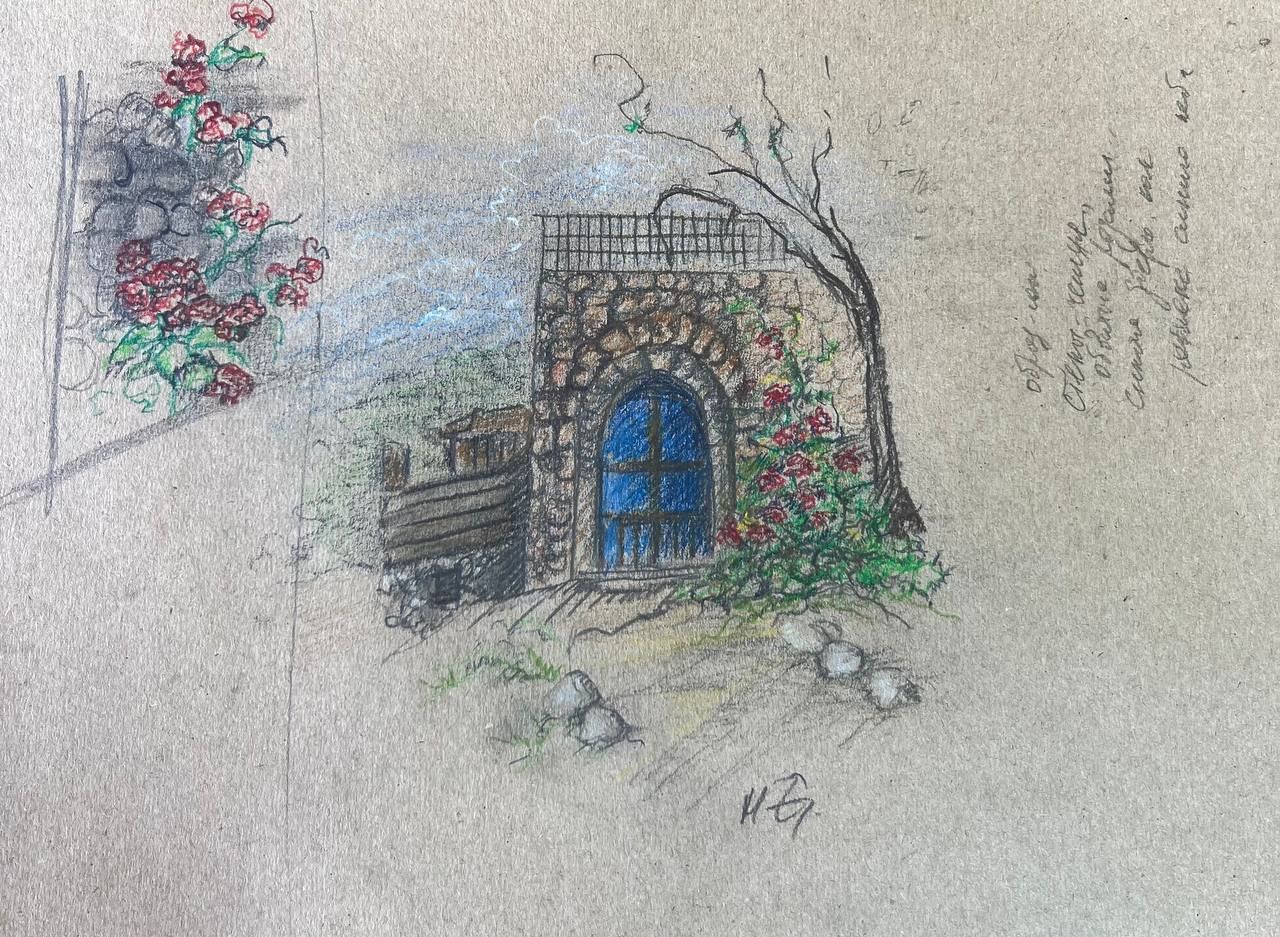
Goris, drawing by Maria Gunko.

Maria Gunko is a DPhil Candidate in Migration Studies, Hill Foundation Scholar at the School of Anthropology and Museum Ethnography University of Oxford. Since 2023, she has joined Yerevan State University as a Visiting Professor. Maria holds an MSc and Kandidat Nauk (Russian post-graduate degree) in Human Geography.
Maria’s research interests lie in the intersection of urban studies and social anthropology, including ethnography of the state, infrastructures, and urban decay with a geographical focus on Eastern Europe and the Southern Caucasus. She is the co-editor of one monograph, author of over thirty scientific articles and op-eds.
Outside In
Essay 1
A Place on the Edge of Armenia’s Urban Geography
Once an agricultural settlement, tidily inscribed into the picturesque mountain landscape, Dastakert was remade by the Soviet state into a site of copper-molybdenum extractivism. That project failed. What happened to the city?
Read moreOutside In
Essay 2
The (Un)Fairytale of Siranush
Following the story of Dastakert, Armenia’s smallest city, this next essay in the “Outside In” series looks behind the veil of yet another small Armenian city and offers a glimpse into the lives of its “void dwellers”, namely Siranush.
Read moreOutside In
Essay 3
After Us
The dissolution of the Soviet Union created vast areas of abandonment and no-go zones that froze in time. In this next essay in the “Outside In” series, Maria Gunko writes that until the material relics of the Soviet Union disappear for good, we are deemed to revisit them, provoking thoughts about what societies value, how they evolve and what they leave behind.
Read moreOutside In
Essay 4
The Female Fix
According to traditional gendered divisions of household labor, repairs fall to the man of the house and his ability to perform such work is very much linked to being seen as a “proper” man. But what about the women? Maria Gunko’s fascinating journey into the realm of the “female fix”.
Read moreOutside In
Essay 5
When Patriarchy and Imperialism Collide: Some Questions of Positionality
In trying to understand her assumptions of her position as a researcher, and the spaces she could access, Maria Gunko uncovered that it was not her ethnicity that informed how she was perceived on the field site, but rather the explosive mixture of her gender and ethnicity.
Read moreOutside In
Essay 6
A Short Colorful Lyrical Digression
In commemoration of renowned Armenian poet Yeghishe Charents, Maria Gunko delves into his colorful universe to see how it captures the essence of Armenia's landscapes and geography, drawing parallels with her perceptions.
Read moreOutside In
Essay 7
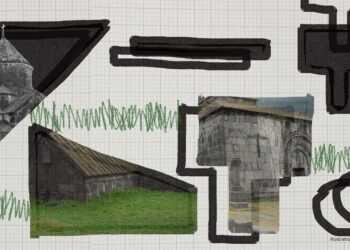
The Shifter Under the Monastery
The surroundings of the Kobayr Monastery are a contrast between the eternal and the fleeting, the essence and the image, serenity and mundane chaos. Maria Gunko’s story is a patchwork of two places and one character who seemingly dwells between them, making a life from what’s available.
Read more
Outside In
Essay 9
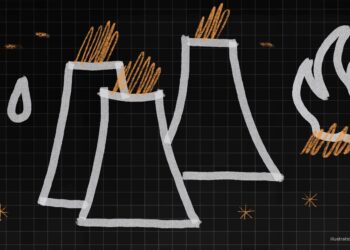
Let There be Light
Being no stranger to post-Soviet 1990s hunger, poverty, and instability in central Russia, Maria Gunko learns about the Armenian experience of the “cold and dark years” at a 2016 exhibit at Yerevan’s History Museum, and is astonished by how little is known about these events outside of Armenian society. In her latest piece, Gunko explores the happiness that comes when the electricity comes.
Read moreOutside In
Essay 10
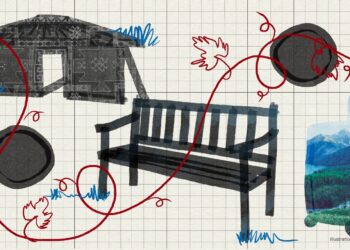
Homeing or It’s All About the Bench
“Homeing” is a fluid process of habituating and domesticating the ever-changing world, where movement—whether migration, modern nomadism, or displacement—is the rule rather than the exception. Maria Gunko writes about her relationship with Home in this next installment of “Outside In.”
Read more